Harden Your ClickHouse® Security With Altinity’s Step-by-Step Guide
Take advantage of ClickHouse’s build-in security features to harden your ClickHouse environment, including user hardening, network communication security, & storage hardening.

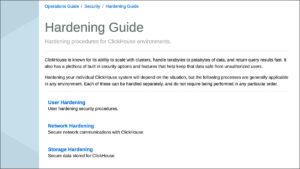
Take advantage of ClickHouse’s build-in security features to harden your ClickHouse environment, including user hardening, network communication security, & storage hardening.

We’ve built Altinity.Cloud as the easiest, fastest and most reliable way for developers around the world to use ClickHouse. With that mission comes the responsibility to protect customer data with the highest standards of security, something we take very seriously.

ClickHouse has traditionally used XML configuration files to define server configuration including all database users. The users.xml configuration file or separate configuration files inside the /etc/clickhouse-server/users.d directory define users and properties associated with them such as profiles, network restrictions, quotas,…

Access control is one of the essential features of database management. Starting in late 2019 ClickHouse contributor Vitaly Baranov began to introduce robust, full-featured Role Based Access Control (RBAC). As a result of this work–which included a huge number of…

ClickHouse AES encryption functions give users a powerful tool for data security and privacy. Learn how to use AES encryption in your analytic applications.

Altinity’s Robert Hodges and Alexander Zaitsev cover ClickHouse® security and privacy: users, RBAC, TLS, encryption, row-level security, and GDPR-aware design.
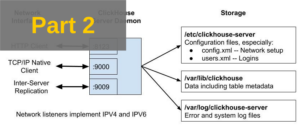
This post in two parts provides an overview of ClickHouse network configuration with lots of examples. In the first post we describe the overall connectivity design and configuration of listeners and ports. In the second post we describe how to…
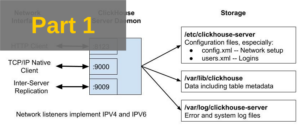
This post in two parts provides an overview of ClickHouse network configuration with lots of examples. In the first post we describe the overall connectivity design and configuration of listeners and ports. In the second post we describe how to…
We use cookies to enhance your experience. By consenting, we can process data like browsing behavior or unique IDs. Without consent, some features may not work as expected.